
Why Capable Organisations Quietly Drift into Unconscious Compromise
Or How Long Is a Piece of Duct Tape?
Most organisations don’t fail because of poor leadership, lack of effort, or weak intent.
They fail — or more often underperform quietly — because they become very good at compensating.
Over time, small fixes are added. Exceptions are made. Workarounds appear. Processes bend. Systems are nudged. People step in to “make things work”.
None of this is irrational. In fact, it is usually the responsible thing to do in the moment.
But gradually, almost invisibly, something shifts. The organisation moves from building deliberately to patching continuously.

The problem with duct tape solutions
Duct tape is useful. It’s fast. It works. And it’s often exactly what you need when something breaks unexpectedly.
The problem is not using duct tape.
The problem is forgetting you’re using it.
In many organisations, duct tape becomes structural.
- Spreadsheets compensate for system gaps.
- Manual checks replace broken flows.
- Local fixes stand in for end-to-end design.
- People carry knowledge and risk that the system no longer holds.
From the outside, things may still look joined up. Reports get produced. Clients are served. Work continues.
But internally, effort increases. Friction spreads. And capability becomes increasingly dependent on individuals compensating for the system, rather than the system supporting the work.
This is what I’ve come to think of as unconscious compromise.
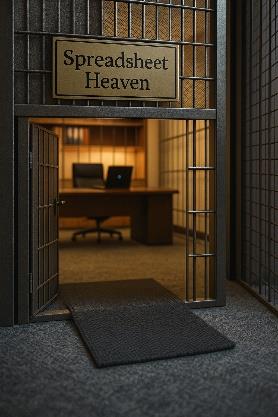
Unconscious compromise isn’t a failure of leadership
One of the most important things to say clearly is this:
Unconscious compromise is not a sign of weak leadership, poor management, or lack of intelligence.
In fact, it often emerges in organisations full of capable, committed people.
It arises because:
- Contexts change faster than systems
- Pressure rewards short-term fixes
- Local success masks systemic strain
- Compensating feels safer than redesigning
Over time, compromises that were once sensible become normal. And once they are normal, they stop being questioned.
Why noticing matters more than fixing
The instinctive response, once these patterns are recognised, is often to jump straight to solutions.
New initiatives. New systems. New governance. New frameworks.
Sometimes those are needed. Often, they come too soon.
In complex organisations, premature action can simply add another layer of duct tape.
What’s usually missing is not action, but discernment:
- Where is effort being absorbed?
- Where are people compensating?
- Where does reality no longer match intent?
- Which compromises are still acceptable — and which are quietly costing too much?
You can’t answer those questions well if you haven’t first paused to notice what’s actually happening.

From noticing to building again
Over a series of LinkedIn posts, I’ve explored these ideas from different angles — duct tape, glue, patching versus building, and the quiet signals that organisations emit when they’re under strain.
Those reflections have now been brought together into a short, reflective leadership Diagnostic.
It’s not a scorecard.
It’s not an assessment.
And it’s not a prescription.
Instead, it’s designed to help leaders notice:
- where ownership and authority may have drifted apart
- how systems really behave under pressure
- where strategy and reality may be diverging
- where workarounds and accidental complexity are carrying hidden load
- and how well the organisation is still able to join things up end-to-end
Sometimes that noticing simply clarifies thinking.
Sometimes it highlights small, sensible improvements.
And sometimes it becomes the starting point for deeper work — helping leadership teams move from coping and patching back to building deliberately again.
The Unconscious Compromise Diagnostic
Reflecting on where your organisation may be under strain
If you’d like access to the Diagnostic, or are curious about the thinking behind it, you’re welcome to get in touch.
Because sometimes, progress doesn’t start with doing more. It starts with noticing what we’ve quietly been compensating for — and asking whether it’s time to build again.